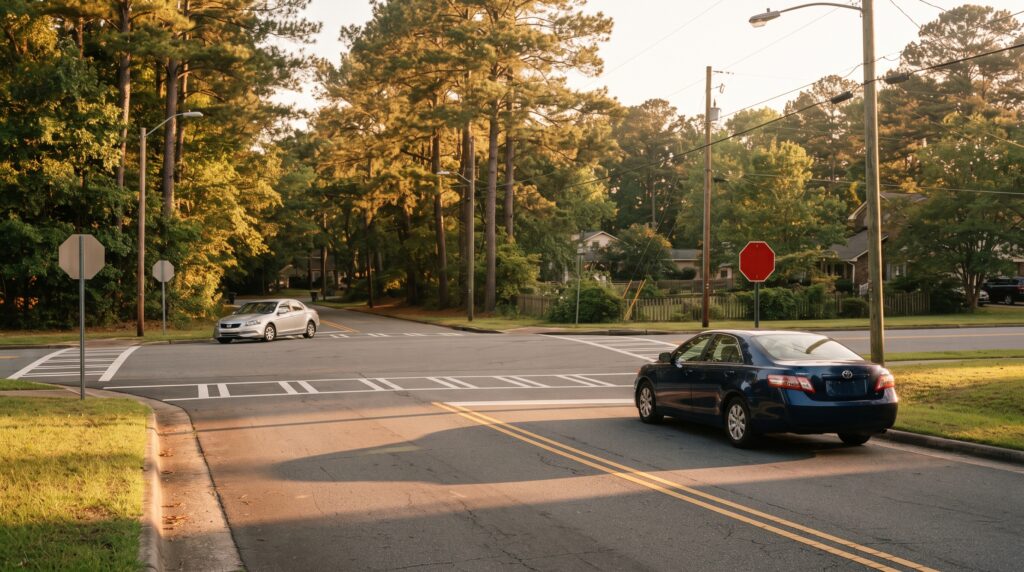
A Rear-end collision in North Carolina is statistically the most common type of traffic accident, and in our state they are far from straightforward personal injury matters. Most people operate under the conventional wisdom that the driver in the back is always at fault. However, that assumption is profoundly complicated by North Carolina’s strict adherence to the doctrine of Contributory Negligence.
For anyone involved in a rear-end crash in this state, the steps you take in the minutes and hours following the incident are not merely procedural—they are often deterministic of the case’s entire outcome.
Why “Simple” Rear-End Crashes Are Actually Complex
In most states, if someone hits you from behind, the insurance claim is relatively simple. But North Carolina is one of the few states that retains the highly restrictive rule of strict Contributory Negligence.
Here is the hard reality: This doctrine dictates that if you (the injured party) are found to be even one percent (1%) responsible for causing or contributing to the accident, you are completely barred from recovering any compensation for your damages. There is no “sliding scale” or partial credit.
Because of this, surviving a rear-end personal injury claim in North Carolina requires an aggressive approach centered on preemptively collecting evidence that proves the complete absence of any negligence on your part.
Common Causes of Rear-End Accidents
To understand how to protect your claim, you have to understand why these crashes happen. They are primarily caused by failures in driver vigilance, judgment, and adherence to foundational traffic laws.
- Distracted Driving Distraction—often from phones or infotainment systems—is the leading cause of failed vigilance. Even a one-second delay in reaction time can eliminate the necessary braking distance when the lead vehicle stops. Proof of cell phone use by the trailing driver is highly determinative in establishing fault.
- Tailgating (Following Too Closely) Tailgating removes the space and time required to react to traffic lights or sudden stops. North Carolina General Statute § 20-152 requires a driver to ensure they are following no more closely than is “reasonable and prudent”. A rear-end crash is frequently the direct result of violating this statutory mandate.
- Adverse Conditions Heavy rain, fog, or night driving impose a higher duty of care. If a driver fails to adjust their speed or distance during poor visibility, they are violating the basic standard of a reasonable driver.
The Defense Strategy: Blaming the Victim
Because the physical facts of a rear-end crash (the collision itself) are hard for the defense to contest, they usually don’t waste time arguing that their driver wasn’t negligent. Instead, they shift their resources toward building a case for Contributory Negligence against you.
They are looking for that 1% of fault. Common arguments include:
- Unsafe Braking: They will allege you stopped unnecessarily, abruptly, or maliciously—often called an “unsafe stop”. They will argue your sudden stop was the proximate cause of the collision.
- Equipment Failure: A very common tactic is to claim your brake lights were dim or not working. If they can prove non-functional lights hindered the other driver’s ability to see you slowing down, they can successfully assert contributory negligence.
- Improper Lane Changes: If you were merging or turning, they may argue you cut them off or created an unavoidable obstacle.
The “Last Clear Chance” Doctrine
There is one major exception to the harsh Contributory Negligence rule: the Last Clear Chance doctrine.
This counter-defense permits a slightly negligent plaintiff to recover damages if they can prove that the defendant had the final opportunity—the “last clear chance”—to avoid the collision but failed to do so. For example, if you made a marginally unsafe lane change, but the other driver had several seconds to see you and brake but didn’t, they might still be liable. However, the burden of proof here is extremely high.
Critical Evidence: Proving You Did Nothing Wrong

In North Carolina, evidence doesn’t just prove the other driver messed up; it must prove you did everything right. The emphasis shifts entirely to what the client didn’t do wrong.
- Scene Documentation
- Photos: You need wide shots showing the position of vehicles and road conditions. Most importantly, if your car still works, take a picture of your rear brake lights illuminated to refute any “equipment failure” defenses.
- Witnesses: A neutral third party who can confirm you stopped reasonably or that your lights worked is invaluable. Get their contact info and a brief summary of what they saw immediately.
- The “Black Box” (EDR) Most modern cars have an Event Data Recorder (EDR) that tracks speed and braking right before a crash. This data is pivotal because it can objectively prove you were not speeding or braking recklessly. You must send a “spoliation letter” immediately to ensure this data isn’t wiped or overwritten.
- Medical Documentation Your medical records must explicitly link your injury to the accident.
- Don’t Wait: Injuries like whiplash often present symptoms 24 to 72 hours later. If you delay treatment, the defense will argue your injuries are unrelated to the crash.
- Specialists: For long-term issues, treatment from specialists (orthopedists, neurologists) carries more weight than primary care alone.
Evidence Summary Table
When to Hire a Lawyer (And Why Timing Matters)
In a strict liability state, the role of the attorney is primarily defensive. The insurance adjuster’s goal is to find that 1% of fault to deny your claim.
- Avoid the Traps: Adjusters will try to get a “recorded statement” from you. This is designed to trap you into inconsistent statements or minimizing your injuries. Counsel will advise you to decline these requests.
- Low-Ball Offers: Insurers love to offer quick, low settlements to unrepresented people, capitalizing on immediate financial distress. These rarely cover the future costs of long-term injuries.
- Statute of Limitations: You generally have three years to file suit. However, waiting too long makes it impossible to gather the forensic evidence (like black box data) needed to win.
Smart Insurance Moves
While you fight the liability battle, you need to understand your own coverage.
MedPay (Medical Payments) This coverage pays your medical bills regardless of who was at fault. It is a critical financial lifeline that keeps your treatment going while the liability dispute drags on.
UM/UIM Coverage North Carolina requires minimum liability limits that are often too low to cover serious injuries. Notably, these limits are set to increase starting July 1, 2025, from $30,000/$60,000 to $50,000/$100,000 for bodily injury. If the at-fault driver has no insurance or low limits, your Underinsured Motorist (UIM) coverage steps in to pay the difference.
Handle Property Damage Separately You should usually settle your property damage claim (fixing the car) separately from your injury claim. This gets you back on the road quickly without closing the door on your injury case, which takes longer to value.
Conclusion: It’s Not Just a Fender Bender
In North Carolina, determining who pays for a rear-end collision is rarely a simple calculation of who hit whom. It is a nuanced legal battle fought over your liability, no matter how remote. Contact us today to schedule a consultation to discuss your rear-end accident today!