North Carolina contributory negligence is one of the strictest fault rules in the country. If you are found even one percent at fault for a crash, you normally recover nothing from the other driver, under the common law doctrine preserved by North Carolina courts and reflected in the state’s pattern jury instructions. North Carolina is one of a small handful of jurisdictions that still follows pure contributory negligence. Most states use some form of comparative negligence instead. If the other driver is uninsured, your own policy’s uninsured motorist coverage, required by state law, becomes the primary source of compensation for your medical bills, lost wages, and property damage.
What Is North Carolina’s Contributory Negligence Rule and Why Does It Matter?
North Carolina follows pure contributory negligence, a doctrine that bars a plaintiff from recovering any damages if they contributed to the crash in any way, even minimally. Most states have moved to comparative negligence systems, where your recovery is reduced proportionally by your share of fault. North Carolina has not.
Pure Contributory Negligence Defined
Under pure contributory negligence, one percent of fault on your part can eliminate your entire recovery. The North Carolina Pattern Jury Instructions for civil cases instruct jurors on this standard. There is no sliding scale and no partial recovery if you share any blame.
How North Carolina Differs from Comparative Negligence States
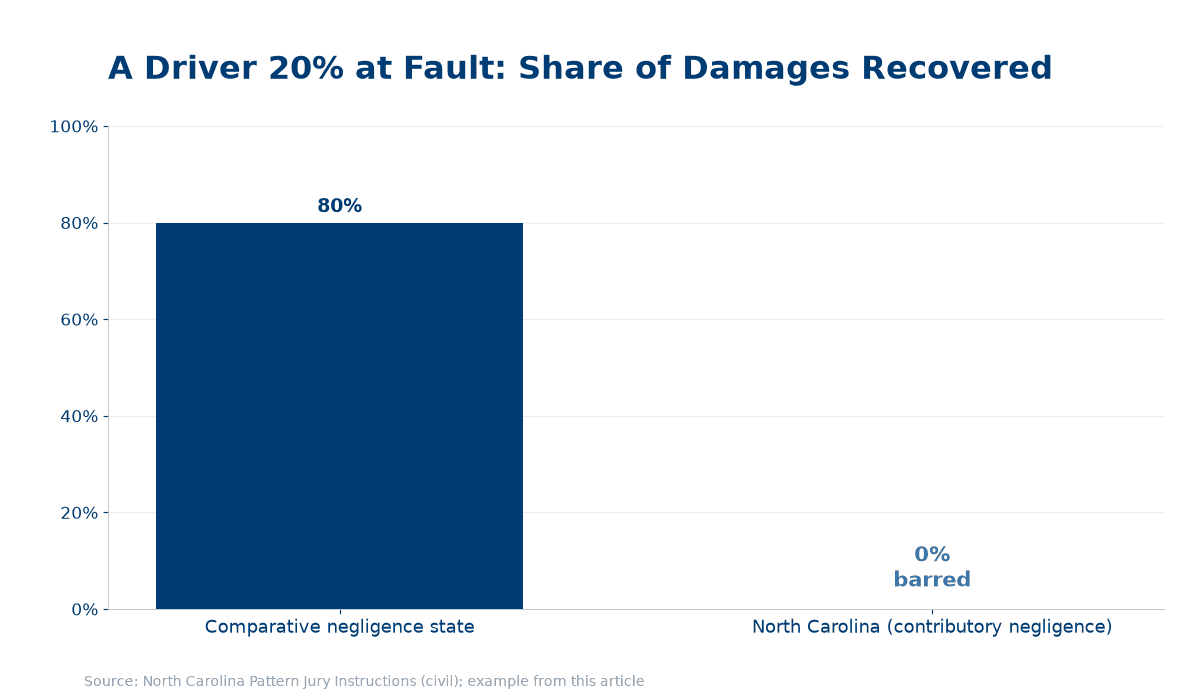
In a comparative negligence state, a driver who is 20 percent at fault can still recover 80 percent of their damages. In North Carolina, that same driver recovers nothing. This distinction is critical when deciding whether to give a recorded statement or accept an early settlement offer, because insurers know that any admission of shared fault can defeat your claim entirely.
Coverage Types at a Glance
- Liability coverage: Pays the other party’s damages when you are at fault, up to your policy limits.
- Collision coverage: Pays to repair your own vehicle regardless of fault, if you purchased it.
- Uninsured motorist (UM): Pays your damages when the at-fault driver has no insurance.
- Underinsured motorist (UIM): Pays the gap when the at-fault driver’s limits fall short of your losses.
- Medical payments (MedPay): Covers medical expenses for you and your passengers regardless of fault.
Why Every Post-Crash Statement Matters
Because any assigned fault can bar your recovery, statements made to adjusters in the hours after a crash carry unusual weight in North Carolina. An offhand apology or imprecise description of events can be used by an opposing insurer to argue contributory negligence. Consulting the car accident lawyers at Harman Law before giving a recorded statement is strongly advisable.
How Does Car Insurance Work When You Cause a Crash in North Carolina?
When you are at fault for a crash, a defined sequence of insurance obligations kicks in.
The Post-Crash Insurance Process
- Exchange information and report the crash to your insurer promptly. Delay can complicate your claim.
- Your liability coverage pays the other party’s damages up to your policy limits for bodily injury and property damage.
- Your collision coverage, if purchased, pays to repair your own vehicle after your deductible.
North Carolina Minimum Liability Limits
Under N.C. Gen. Stat. 20-279.21, the minimum liability limits rose for policies newly issued or renewed on or after July 1, 2025. The North Carolina Department of Insurance puts the current minimums at $50,000 per person and $100,000 per accident for bodily injury, plus $50,000 for property damage. The prior limits were $30,000, $60,000 and $25,000, so the date your policy was issued or renewed matters. These minimums are a floor, not a recommendation. If damages exceed your limits, you may be personally responsible for the difference.
Worked Scenario
Suppose you cause a crash resulting in $40,000 in property damage and $95,000 in injuries to the other driver. A policy written at the current minimums covers the full property damage claim and $50,000 of the injury claim, leaving a $45,000 gap the injured driver could pursue from you personally.
What Happens to Your Premium
An at-fault claim typically triggers a surcharge at renewal. Review your policy’s surcharge schedule before assuming your rate will stay flat.
What Happens If the At-Fault Driver Is Uninsured in North Carolina?
North Carolina law requires every auto policy to include uninsured and underinsured motorist coverage. When the driver who hit you carries no insurance, your own UM coverage becomes your primary source of compensation.
UM vs. UIM vs. Hit-and-Run: What Each Pays
| Coverage | When It Applies | What It Pays |
|---|---|---|
| UM | At-fault driver has no insurance | Your medical bills, lost wages, pain and suffering, up to your UM limits |
| UIM | At-fault driver’s limits are lower than your losses | The gap between their limits and your total damages |
| Hit-and-run | At-fault driver is unknown or flees | Treated as a UM claim; physical contact requirement may apply |
Will Filing a UM Claim Raise My Rates?
North Carolina law limits an insurer’s ability to surcharge a policyholder for a UM claim when the insured was not at fault. Ask your insurer directly about surcharge rules before filing.
Suing the Uninsured Driver Directly
You can sue an uninsured driver personally, but collecting a judgment against someone with no insurance and limited assets is often difficult. Pursuing your own UM coverage is usually faster and more practical.
Are There Any Exceptions to North Carolina’s Contributory Negligence Bar?
The bar imposed by north carolina contributory negligence is nearly absolute, but two narrow exceptions exist under state law and court decisions.
Last Clear Chance Doctrine
The last clear chance doctrine allows a contributorily negligent plaintiff to recover if the defendant had the final opportunity to avoid the crash and failed to take it. It is narrow and difficult to establish without strong evidence.
Gross or Willful Negligence
Conduct rising to gross or willful negligence may overcome the contributory negligence bar in limited circumstances. Proving it requires showing conduct that goes well beyond ordinary carelessness, and these cases are fact-intensive.
Why These Exceptions Are Hard to Win
Both exceptions require specific factual showings that are challenging to prove without thorough investigation and expert analysis. Do not assume an exception applies without speaking with a North Carolina personal injury lawyer.
What Should You Do in the Days After a North Carolina Crash?
The steps you take immediately following a crash directly affect the strength of your claim.
- Preserve evidence: Photograph the scene, vehicle damage, injuries, and road conditions. Collect witness names and the police report number.
- Seek medical attention promptly: Gaps in treatment are routinely used by insurers to argue injuries were not serious or were caused by something other than the crash.
- Be careful with recorded statements: Do not give a recorded statement to any insurer before speaking with an attorney.
- Understand your deadlines: Under N.C. Gen. Stat. 1-52, you generally have three years from the crash date to file a negligence lawsuit. Wrongful death claims must be filed within two years under N.C. Gen. Stat. 1-53(4).
- Workplace crash rule: If your crash occurred in the course of employment, a 30-day written notice rule applies to your workers’ compensation claim under N.C. Gen. Stat. 97-22. Missing that window can jeopardize your workers’ comp benefits.
How Can an Attorney Help When Contributory Negligence Is Disputed?
When fault is disputed, the difference between recovering fully and recovering nothing often comes down to how thoroughly the case is investigated and presented.
Investigating and Contesting Fault
Attorneys gather surveillance footage, cell phone records, weather data, and physical evidence to establish how the crash happened. If an insurer tries to assign even a small percentage of fault to you, your attorney can challenge that characterization before it becomes final.
Accident Reconstruction and Expert Witnesses
In complex crashes, accident reconstruction specialists model vehicle speeds, impact angles, and braking patterns to establish who had the opportunity to avoid the collision. Expert testimony is often the deciding factor when contributory negligence is seriously argued by the defense.
When a Crash Overlaps with Workers’ Comp or Employment Law
If you were injured while driving for work, you may have both a personal injury claim against the other driver and a workers’ compensation claim in North Carolina. If your employer retaliated against you for filing that claim, an employment law issue layers on top. Harman Law handles all three tracks from offices in Charlotte, Huntersville, Hickory, and Rocky Mount.
Schedule a Consultation at Harman Law in Charlotte
North Carolina’s contributory negligence rule gives insurers a powerful tool to deny your claim, and they use it aggressively. Harman Law represents injured drivers, passengers, and pedestrians across Charlotte, Huntersville, the Lake Norman area, Hickory, and Rocky Mount. Whether your case involves a disputed fault question, an uninsured driver, or a crash that also affects your job, the firm is equipped to protect your interests on every front. Contact Harman Law today to talk through your situation before you say anything to an insurer.