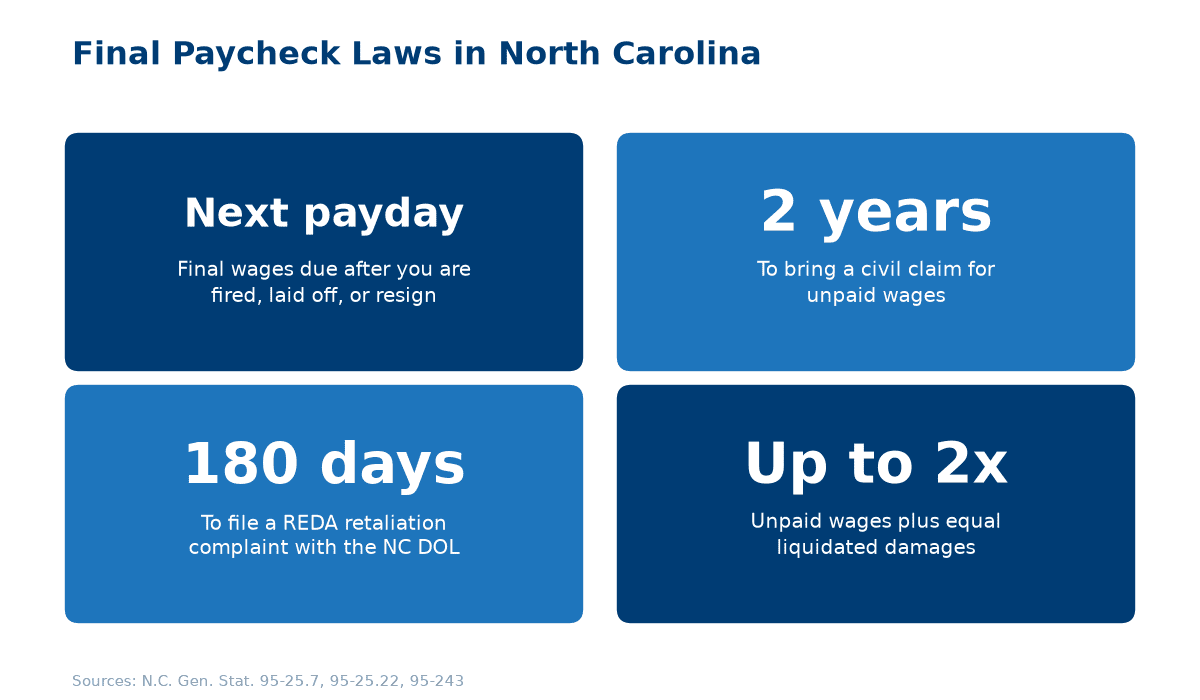
Under the final paycheck laws in North Carolina, specifically N.C. Gen. Stat. 95-25.7, your employer must pay all earned wages on or before the next regular payday after your last day of work, whether you were fired, laid off, or resigned. If your pay includes commissions or bonuses that cannot be calculated by that payday, those amounts are due on the first calculable payday under N.C. Gen. Stat. 95-25.7. Missing that deadline is a wage violation, and this post explains your options.
What Does ‘Next Regular Payday’ Actually Mean for Your Situation?
“Next regular payday” is tied to the pay schedule your employer had already established before your separation, not to any arbitrary date after your last day.
How to identify your next regular payday under your employer’s pay schedule
Check your most recent pay stubs. If your employer paid you every other Friday, the next regular payday is the first Friday in that cycle after your last day.
What happens if your last day falls on a holiday or the day before a payday
Your wages are still due on that scheduled payday. If payroll runs that day for other employees, it must run for you too.
Whether your employer can hold your check until you return company property
No. Holding the check past the next regular payday is a separate wage violation under the North Carolina Wage and Hour Act. The employer has other legal avenues to recover property; delaying your wages is not one of them.
Which Wages Must Be Included in Your Final Paycheck?
Regular hourly or salary wages for all hours worked through your last day
Every hour you worked through your final day must be paid at your regular rate, including partial days, approved overtime, and shift differentials.
Accrued, unused paid time off: what North Carolina law says and what your written policy controls
North Carolina does not automatically require employers to pay out unused vacation or paid time off at separation. Under N.C. Gen. Stat. 95-25.12, accrued leave must be paid only if your employer’s written policy or employment agreement promises it.
Commissions and bonuses: the ‘first calculable payday’ rule
Under the NC Department of Labor’s guidance on payment of final wages, commissions and bonuses are due on the first regular payday after they become calculable. If your commission cannot be verified until thirty days after separation, it is still owed; the deadline shifts to the first payday after the number is confirmed.
Expense reimbursements and other amounts owed under your written pay agreement
If your employment agreement or a written company policy promised reimbursement for approved expenses, those amounts are wages under North Carolina law and must be paid by the applicable deadline.
What Can Your Employer Legally Deduct from Your Final Check?
Authorized deductions: the written-authorization requirement under N.C. Gen. Stat. 95-25.8
Most deductions from wages, other than taxes and court-ordered withholdings, must be authorized in writing by the employee before the deduction is taken.
Deductions that are never permitted regardless of company policy
An employer cannot deduct amounts solely for the employer’s benefit outside the written-authorization framework. A company policy attempting to authorize these deductions does not override the statute.
How uniform, equipment, or training-cost deductions must be structured to be lawful
The written authorization must identify the specific item and amount and must have been signed before the cost was incurred. A deduction announced only at termination does not meet that standard.
What to do if a deduction drops your pay below minimum wage for the pay period
Even a properly authorized deduction cannot reduce your effective pay below the applicable minimum wage for the pay period.
How Do You File a Wage Complaint If Your Employer Misses the Deadline?
If your employer missed the deadline or shorted your final check, you have two main paths: a complaint with the state agency or a civil lawsuit.
Filing a wage complaint with the NC Department of Labor Wage and Hour Bureau
You can file a complaint with the NC Department of Labor Wage and Hour Bureau at no cost. The bureau investigates wage violations and can order payment of back wages through an administrative process.
The two-year statute of limitations for wage and overtime claims
Under N.C. Gen. Stat. 95-25.22, you generally have two years from the date the wages were due to bring a civil action. For wage and overtime claims in North Carolina, that clock starts from the payday on which the wages should have appeared.
Potential remedies: back pay, liquidated damages, and attorney fees
A successful claim may entitle you to unpaid wages plus liquidated damages equal to the unpaid amount, effectively doubling the recovery. The court may also award reasonable attorney fees, meaning you may be able to pursue a claim without paying legal fees out of pocket upfront.
When a private lawsuit is the right next step after an agency complaint
The agency complaint and a civil lawsuit are not mutually exclusive. An attorney can help you evaluate which path fits your situation.
Could a Withheld Paycheck Be Retaliation for Something You Reported?
If you reported a wage violation, a workplace safety issue, or discrimination before separation, the timing of a withheld check deserves close attention.
What counts as protected activity under the Retaliatory Employment Discrimination Act
Under N.C. Gen. Stat. 95-241, protected activity includes filing a complaint, testifying, participating in any proceeding related to state labor and safety laws, or refusing to violate those laws.
The 180-day deadline to file a REDA complaint
You have 180 days from the retaliatory act to file a complaint with the NC Department of Labor under N.C. Gen. Stat. 95-243. Contact an employment retaliation attorney before that deadline passes.
How a withheld final check can be evidence of retaliation
A check held only after you filed a complaint, or docked in an amount that tracks a grievance you raised, can serve as evidence that the employer acted for retaliatory rather than legitimate payroll reasons.
When a wage complaint and a retaliation complaint run on separate clocks at the same time
The two-year wage claim clock and the 180-day REDA clock run independently. Missing one deadline does not extend the other.
What If You Were Misclassified as an Independent Contractor?
If your employer called you a contractor, that label does not automatically make it true.
How North Carolina defines ’employee’ for Wage and Hour Act purposes
North Carolina courts and the NC Department of Labor apply an economic realities test. Control over how the work is done, whether you work exclusively for one company, and whether the relationship is indefinite all bear on the analysis.
Why misclassified workers may still be entitled to final-paycheck protections
If the economic realities show you functioned as an employee, you may be entitled to the same final-paycheck protections as any other worker, regardless of how you were classified on paper.
The overlap between worker misclassification, unpaid wages, and federal FLSA claims
Misclassification can trigger claims under both state and federal law. The Fair Labor Standards Act provides parallel protections. For a full picture of worker misclassification and your rights, speak with an attorney who handles both state and federal wage claims.
Steps to take if your employer disputes that you were an employee at all
Gather every document reflecting how the work relationship actually operated: emails assigning tasks, schedules, training materials, and written agreements. The more you can show about day-to-day control, the stronger the economic realities analysis becomes.
Contact Harman Law in Charlotte About Your Final Paycheck
If your employer has missed the deadline, shorted your check, or withheld wages after you reported something at work, the law gives you real tools to recover what you are owed. Harman Law handles wage and overtime claims, retaliation cases, and misclassification disputes for workers across Charlotte, Huntersville, Hickory, and Rocky Mount. Call Harman Law or reach out through harmanlawnc.com to talk through your situation with an attorney who knows North Carolina wage and hour law.