No single medical condition automatically guarantees approval for Social Security Disability benefits, and understanding what conditions automatically qualify you for disability requires knowing how the SSA actually evaluates claims. The Social Security Administration reviews every application under a five-step sequential evaluation process governed by 20 CFR Part 404, Subpart P, which requires that your condition appear in the SSA’s Listing of Impairments (the Blue Book) or otherwise prevent any substantial gainful activity for at least 12 continuous months. Certain severe diagnoses are fast-tracked through the SSA’s Compassionate Allowances program, but fast-tracked does not mean automatic: medical documentation must still satisfy SSA criteria. If you are a working adult in Rocky Mount or anywhere in Nash County facing a serious illness, injury, or mental health condition, understanding how the SSA’s system works before you apply can make a significant difference in your outcome.
What Is the SSA Blue Book and How Does It Define Qualifying Conditions?
The SSA Blue Book, formally titled Disability Evaluation Under Social Security, is the agency’s official medical reference for determining whether a condition qualifies as a disability. It is the starting point for every claim.
The Blue Book’s 14 Body-System Categories
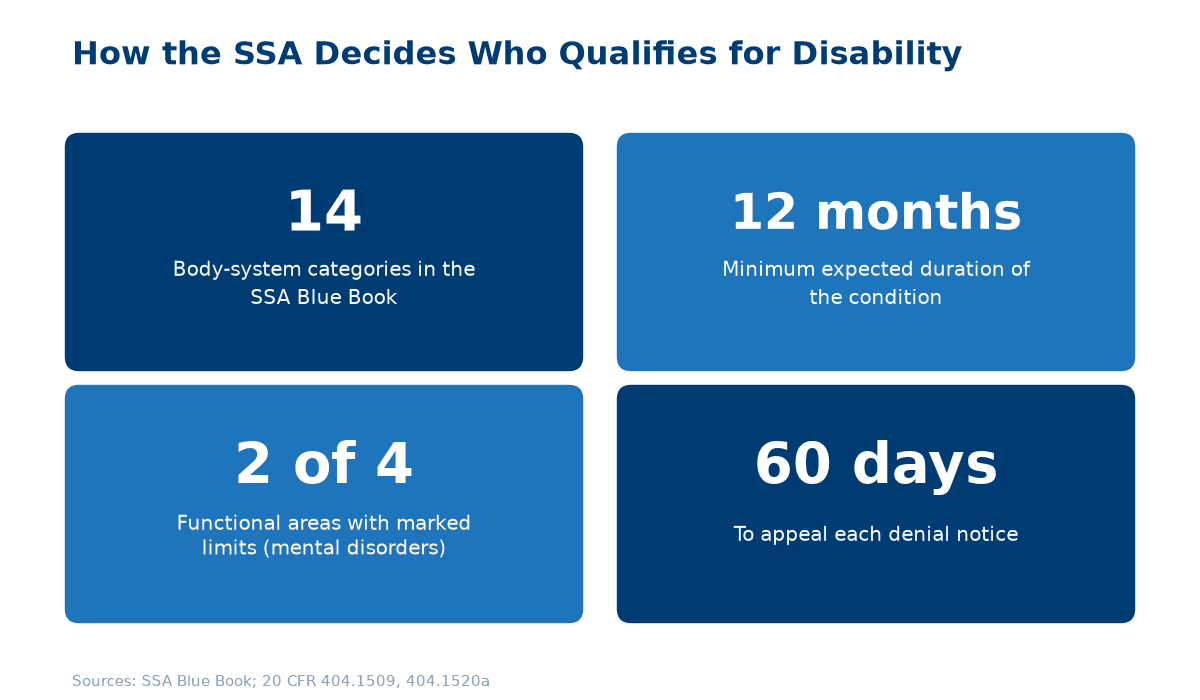
The Blue Book organizes qualifying conditions into 14 body-system categories, including musculoskeletal disorders, cardiovascular conditions, respiratory illnesses, neurological impairments, mental disorders, and immune system conditions. Each listing spells out the specific clinical findings, imaging results, laboratory values, or functional limitations you must document to meet that listing.
Meeting a Listing Is Not Automatic Approval
Even if your diagnosis appears in the Blue Book, meeting a listing requires satisfying every clinical criterion in that listing, not just carrying the diagnosis. The SSA also confirms that your condition has lasted or is expected to last at least 12 months, and that your work history meets the insured-status requirements. The governing federal regulation is 20 CFR Part 404, Subpart P, Appendix 1.
If you do not meet a listing exactly, the SSA may still find you disabled through a medical-vocational allowance, which considers your age, education, work experience, and residual functional capacity. This pathway matters for many Rocky Mount residents who have physically demanding work histories in manufacturing or logistics.
Which Conditions Are Fast-Tracked Through Compassionate Allowances?
The SSA’s Compassionate Allowances program identifies conditions so severe that they nearly always meet disability standards, allowing the agency to shorten the initial review timeline. The SSA’s Compassionate Allowances list covers a long list of severe conditions.
What Conditions the Program Covers
Current Compassionate Allowances conditions include:
- Aggressive cancers: Pancreatic cancer, esophageal cancer, and certain Stage IV solid tumor cancers
- Neurological conditions: Early-onset Alzheimer’s disease and ALS (amyotrophic lateral sclerosis)
- Rare pediatric disorders: Conditions such as Batten disease and certain chromosomal disorders
- Other severe diagnoses: Certain rare blood disorders and inflammatory conditions
Fast-Track Does Not Mean Paperwork-Free
Fast-track review shortens the initial determination timeline, but it does not eliminate documentation requirements. A diagnosis alone, without supporting clinical records, imaging, and treating-provider notes, will not satisfy the SSA. Applicants with Compassionate Allowances conditions still need complete medical files to receive an expedited approval.
What Mental Health Conditions Can Qualify for Social Security Disability?
Mental health conditions are among the most misunderstood areas of disability law. Many people living with depression, anxiety, PTSD, or bipolar disorder wonder how to get disability for depression and anxiety, or how to prove a mental disability to the SSA’s satisfaction.
Blue Book Section 12 and the Four Functional Areas
Mental disorders are listed in Blue Book Section 12, which covers depressive disorders, bipolar disorder, anxiety and obsessive-compulsive disorders, trauma and stressor-related disorders, and psychotic disorders. To satisfy a Section 12 listing, you generally must show marked limitations in at least two of four functional areas:
- Understanding and applying information
- Interacting with others
- Concentrating, persisting, or maintaining pace
- Adapting or managing oneself
What Documentation the SSA Needs
Depression or anxiety alone rarely satisfies a Blue Book listing without a documented treatment history. The SSA uses a Psychiatric Review Technique under 20 CFR 404.1520a to assess functional limitations. Detailed psychiatric records, medication logs, therapy notes, and written statements from treating providers all strengthen a mental health claim. If you have been receiving care from a Rocky Mount or Nash County provider, those records are central to proving your functional limits.
How Does a Workplace Injury in Rocky Mount Lead to a Disability Claim?
For many Nash County workers, a serious on-the-job injury is what triggers a disability claim. Rocky Mount’s manufacturing and logistics sectors carry real physical risk, and a single catastrophic event, such as a traumatic brain injury or spinal cord injury, can permanently end someone’s ability to work.
Two Claims, Two Different Clocks
Workers’ compensation under N.C. Gen. Stat. Chapter 97 is generally the exclusive remedy against your employer for the injury itself, but it does not prevent you from filing a separate Social Security Disability claim. The two claims run on different timelines and are governed by separate agencies:
- Workers’ compensation: Must be filed with the North Carolina Industrial Commission within two years under N.C. Gen. Stat. 97-24
- Social Security Disability: Appeals at each stage must be filed within 60 days of each denial notice
When temporary total disability benefits under workers’ compensation run out and the worker still cannot return to any job, Social Security Disability becomes the next layer of income protection. Coordinating workers’ compensation claims in North Carolina alongside an SSD application from the start helps protect both claims.
What Happens If You Are Denied and How Do Rocky Mount Residents Appeal?
The SSA denies many initial applications. A denial letter is not the end of the process; it is the beginning of the appeals process, and the timeline is strict.
The Four Levels of SSA Appeal
After an initial denial, you have 60 days from the date of the denial notice to request the next level of review. The four levels are:
- Reconsideration: A second SSA reviewer examines the file
- ALJ Hearing: A hearing before an Administrative Law Judge, where medical evidence and vocational expert testimony become central
- Appeals Council: Review by the SSA’s national Appeals Council
- Federal Court: A civil action in U.S. District Court
Rocky Mount residents file hearings through the SSA’s Raleigh Hearing Office, which covers Nash County. Missing a 60-day deadline generally requires you to restart the entire process from scratch, losing your original filing date and potentially thousands of dollars in back pay.
What Should You Do This Week If You Think You Qualify?
If you believe a medical condition may qualify you for disability benefits, the steps you take in the next few days can shape the outcome of your claim. Here is where to start:
- Gather records now: Collect all medical records, treatment notes, imaging, lab results, and work-history documentation before you apply
- Check the Blue Book and Compassionate Allowances: Note whether your condition appears on either list at ssa.gov
- File workers’ compensation if applicable: If a workplace injury caused or contributed to your condition, confirm your claim under N.C. Gen. Stat. 97-24 is already on file with the North Carolina Industrial Commission
- Watch for retaliation: If you were terminated or pushed out after reporting an injury or requesting medical leave, that may be a separate employment retaliation after a workplace injury claim under the Retaliatory Employment Discrimination Act, N.C. Gen. Stat. 95-241, with a 180-day filing window
- Talk to an attorney before any deadline closes: The SSD and workers’ compensation deadlines are unforgiving, and a missed window can reset your entire claim
Schedule a Consultation at Harman Law in Rocky Mount
Harman Law’s Rocky Mount office helps working- and middle-income adults navigate Social Security Disability claims, workers’ compensation, and employment retaliation, often all three arising from a single workplace event. If you are trying to understand which conditions qualify for disability benefits, or if you have already received a denial, our team can review your medical records, evaluate your claim across every applicable track, and represent you before the SSA and North Carolina courts. Contact Social Security Disability representation in Rocky Mount through Harman Law today, before any appeal deadline closes.