
Yes, you can be fired while on FMLA leave in North Carolina, but only in narrow situations where the employer can prove the termination would have happened regardless of the leave. The Family and Medical Leave Act protects eligible employees against termination, demotion, and retaliation tied to protected leave, and the burden of proof sits squarely on the employer. So if you’ve been fired during or shortly after FMLA leave, your employer is the one on the defensive, not you. A Charlotte employment lawyer can review your timing, your documentation, and your employer’s stated reason, then tell you whether you have a claim worth pursuing.
At Harman Law, we represent North Carolina employees who’ve been terminated, demoted, or retaliated against in connection with FMLA leave. We’ve seen every variation of the same pattern: the perfect performance review the week before the leave request, the sudden restructuring that happens to eliminate only the absent employee’s position, the vague claim that the company would have made the same decision anyway. Understanding the protections the FMLA gives you, and the narrow exceptions an employer can lawfully invoke, is the first step in deciding what to do next.
What the FMLA Actually Protects
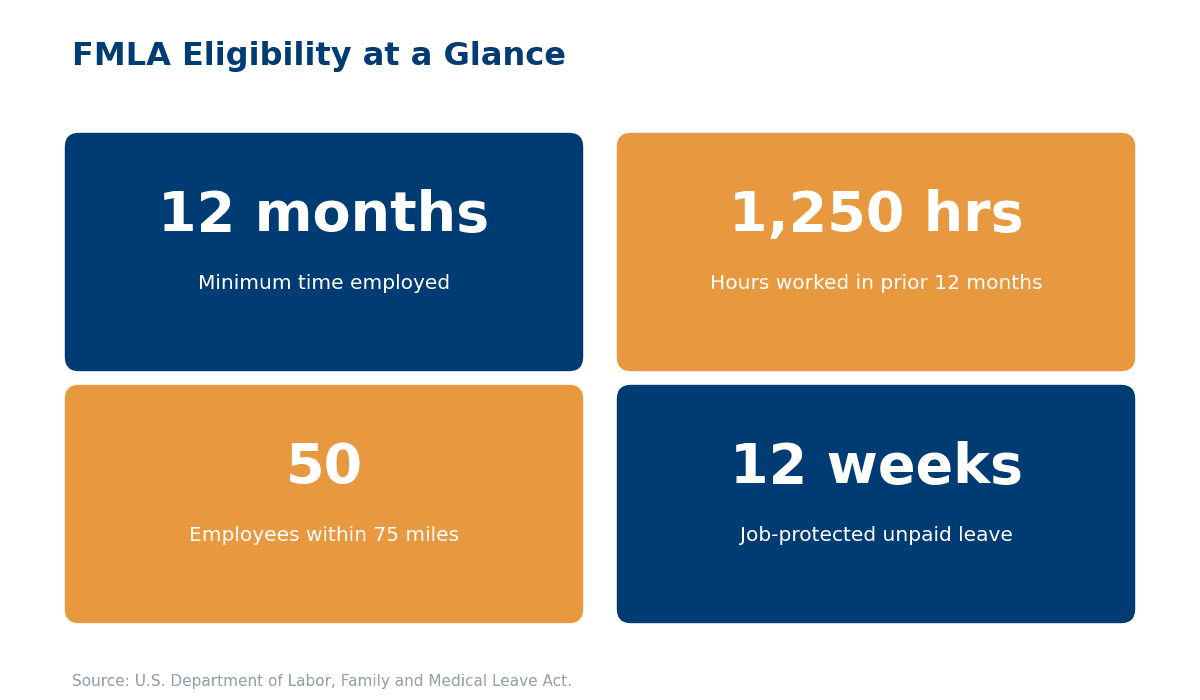
The Family and Medical Leave Act entitles eligible employees of covered employers to up to 12 weeks of unpaid, job-protected leave in a 12-month period for a qualifying reason. The U.S. Department of Labor FMLA page lays out the federal eligibility rules in detail. The qualifying reasons include the birth or placement of a child, a serious health condition that makes the employee unable to perform their job, caring for an immediate family member with a serious health condition, and certain military-related exigencies.
To be eligible, an employee must meet all three of the following:
- Worked for the employer for at least 12 months.
- Logged at least 1,250 hours during the prior 12 months.
- Work at a location where the employer has 50 or more employees within 75 miles.
The FMLA contains two distinct protections that matter when termination is on the table. First, there’s the right to job restoration. When leave ends, the employee must be reinstated to the same position or an equivalent one. Second, there’s the protection against interference and retaliation under 29 U.S.C. § 2615, which makes it unlawful for any employer to interfere with, restrain, or deny FMLA rights, or to retaliate against an employee for taking protected leave.
When Termination During FMLA Leave Is Lawful
FMLA does not create absolute job protection. An employer can lawfully terminate an employee on FMLA leave if the termination would have happened regardless of the leave. Here are the most common examples:
- A company-wide layoff that includes the employee on neutral, pre-existing criteria.
- Documented misconduct that came to light independently of the leave.
- Elimination of the entire department or position for legitimate business reasons.
- Completion of a fixed-term contract or seasonal position that was set to expire during the leave window.
The key legal question is whether the employer can prove the decision would have been the same had the employee never taken leave. North Carolina is an at-will employment state, which means an employer generally doesn’t need a reason to terminate an employee. The FMLA carves out a meaningful exception, though, and the employer carries the burden of proving the legitimate business reason in court. This is where most employers fail. They can’t resist using the leave period to make staffing decisions they’d been weighing for months, and they often can’t produce contemporaneous documentation showing the termination was already planned.
FMLA Interference vs. FMLA Retaliation
These are two distinct claims, and many cases involve both. Understanding the difference matters because the standard of proof and the available defenses aren’t the same for each one.
FMLA Interference
Interference happens when an employer does anything that prevents, obstructs, or discourages an employee from exercising FMLA rights. Common examples include denying a valid leave request, requiring an employee to perform work during approved leave, failing to restore the employee to the same or equivalent position after leave ends, counting FMLA-protected absences against an attendance policy, or making the employee feel their job is at risk if they take the full 12 weeks. Interference claims don’t require proof of bad intent. The question is simply whether the employer’s conduct denied a benefit the FMLA guarantees.
FMLA Retaliation
Retaliation requires the employee to show three things: that they engaged in protected activity (taking or requesting FMLA leave), that the employer took an adverse action (termination, demotion, pay cut, hostile reassignment), and that there’s a causal connection between the two. Causation is most often proven through timing, such as a termination within days or weeks of the leave request, documented hostility toward the leave, or a sudden shift in performance evaluations after years of positive reviews. Retaliation doesn’t require that the leave be the only reason for the adverse action. If it was a motivating factor, the employer is liable.
How to Document an FMLA Termination Claim
If you suspect your termination is connected to FMLA leave, start documenting right away. The strongest cases are built when evidence is preserved within days of the adverse action, before the employer has time to rewrite the paper trail. Take the following steps right away:
- Save every communication with your employer about the leave: the original request, the approval, any extension discussions, and messages during leave.
- Keep copies of your most recent performance reviews, commendations, and the job description for your position.
- Request the written justification for any position elimination, and the names of other employees affected.
- Preserve text messages, emails, and Slack/Teams threads that reference the leave or your return.
- Note the dates and substance of any conversations with HR or your manager about the leave.
Don’t rely on your employer’s internal HR process to protect you. The statute of limitations for FMLA claims is two years from the violation, or three years if the violation was willful, but evidence becomes harder to obtain as time passes.
Schedule a Consultation With a North Carolina FMLA Lawyer
If you’ve been terminated, demoted, or retaliated against in connection with FMLA leave in North Carolina, federal law gives you rights that go well beyond what state at-will doctrine suggests. Successful FMLA claims can recover lost wages, lost benefits, liquidated damages equal to those losses, reinstatement or front pay, and attorney’s fees. Contact us by scheduling a consultation online to talk through your situation before the statute of limitations starts to close out your options.