
Yes, you can sue your employer while still working for them in Charlotte, North Carolina. Federal and state law protect employees who file claims for discrimination, unpaid wages, harassment, or retaliation from being fired or punished for doing so. If your employer retaliates after you file, the Retaliatory Employment Discrimination Act, N.C. Gen. Stat. 95-241, gives you an additional claim, but you must file that complaint with the North Carolina Department of Labor within 180 days of the retaliatory act.
Quick Answer: What Gives You the Right to Sue While Still Employed?
- Valid legal claim: You must have a recognized claim, such as discrimination, unpaid wages, harassment, wrongful termination threat, or retaliation.
- No resignation required: You do not need to quit first to file most employment claims.
- Federal anti-retaliation protections: Title VII, the Fair Labor Standards Act, and the ADA protect you the moment you engage in protected activity.
- State-law layer: North Carolina’s Retaliatory Employment Discrimination Act, N.C. Gen. Stat. 95-241, adds protections on top of federal law.
- Deadlines start immediately: Key filing windows begin running from the date of the employer’s unlawful act, not the date you leave the job.
What Types of Claims Can Charlotte Employees File Against a Current Employer?
Charlotte workers may pursue a range of employment claims without leaving their jobs.
- Wage and overtime violations: Unpaid minimum wage or overtime under the Fair Labor Standards Act (29 U.S.C. 201 et seq.) and the North Carolina Wage and Hour Act, N.C. Gen. Stat. 95-25.1 et seq. Our wage and overtime claims team handles these cases regularly.
- Employment discrimination: Race, sex, age, disability, religion, or national origin discrimination under Title VII, the Age Discrimination in Employment Act, and the ADA.
- Sexual harassment and hostile work environment: Claims under Title VII apply when conduct is severe or pervasive enough to alter your working conditions.
- FMLA interference or retaliation: Employers cannot deny or punish you for taking protected leave under 29 U.S.C. 2601 et seq.
- Whistleblower and retaliation claims: Covered under N.C. Gen. Stat. 95-241 when you report safety violations, wage theft, or other illegal conduct.
- Worker misclassification: If you are treated as an independent contractor but meet the legal definition of an employee, you may be owed wages, benefits, and tax protections.
A note on workers’ compensation: If your claim involves a workplace injury, workers’ compensation under N.C. Gen. Stat. 97-9 and 97-10.1 is generally the exclusive remedy against your employer, not a civil lawsuit. Narrow exceptions exist, and a separate claim against a negligent third party may still be available.
Do You Have the Evidence You Need Before Filing in Charlotte?
Building a strong record before you file is one of the most important steps you can take. Courts and agencies look for documentation showing a pattern of conduct and a clear timeline.
What to gather before you file
- Offer letters, pay stubs, performance reviews, written warnings, and your employee handbook
- Emails, text messages, and other written communications about the conduct at issue
- A personal log of dates, times, locations, and witnesses for every relevant incident
- Copies of any HR complaints you submitted and any responses you received
Save everything to a personal device or personal email account, not a work system you could lose access to overnight. Charlotte sits in Mecklenburg County, served by the EEOC Charlotte Field Office, which workshares with the North Carolina Human Relations Commission and affects your filing deadline.
What Are the Filing Deadlines Charlotte Employees Cannot Miss?
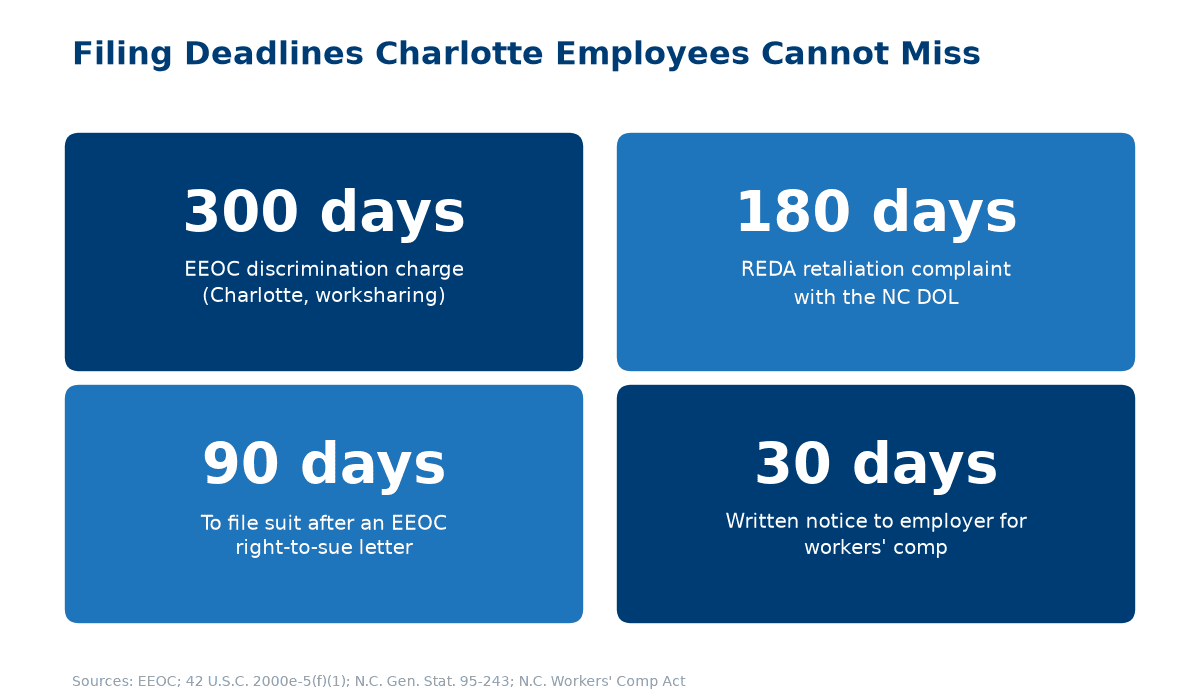
Missing a filing deadline typically kills a claim entirely. Here are the key windows that apply to Charlotte workers.
| Claim Type | Deadline | Governing Law |
|---|---|---|
| EEOC charge (discrimination) | 300 days (Charlotte, due to worksharing) | EEOC charge filing rules |
| Right-to-Sue suit in federal court | 90 days from letter | 42 U.S.C. 2000e-5(f)(1) |
| FLSA wage claim | 2 to 3 years (3 if willful) | FLSA overview |
| REDA retaliation complaint | 180 days from retaliatory act | N.C. Gen. Stat. 95-243 |
| FMLA retaliation | 2 to 3 years (3 if willful) | 29 CFR 825.400 |
| Workers’ comp claim | 2 years; 30-day written notice to employer | N.C. Workers’ Comp Act |
These clocks run from the date the unlawful act occurred, not from the date you resign or are terminated. Waiting to see whether things improve is one of the most common reasons employees lose the right to file.
What Happens to Your Job in Charlotte If You File a Claim?
Retaliation is illegal, and if it happens, you gain an additional legal claim. Your employer cannot fire you, demote you, cut your pay, reduce your hours, or alter your schedule because you filed a protected claim or helped someone else do so. If any of those things happen after you file, document every change in writing immediately: the date, the person who made the decision, and anything said to justify it.
You can add a retaliation claim to an open case or file a separate REDA complaint with the North Carolina Department of Labor. Our employment retaliation attorneys regularly help Charlotte workers pursue both the underlying claim and any retaliation that follows. If your hours were quietly cut or a sudden negative review appeared after you filed, that pattern matters legally.
Constructive discharge is one scenario worth understanding: if your employer makes your working conditions so intolerable that a reasonable person in your position would feel forced to quit, the law can treat that resignation as a termination for purposes of your claim.
Is It Worth Suing Your Employer, and When Should You Start the Process in Charlotte?
Suing is generally a last step after internal reporting fails, but some claims, particularly EEOC charges for discrimination, must go through a government agency before you can file suit in court.
- Report internally: Submit your complaint to HR or a supervisor in writing, unless doing so would put you at immediate physical or professional risk.
- File the agency complaint: Depending on your claim, this means the EEOC Charlotte Field Office, the North Carolina Department of Labor, or the North Carolina Industrial Commission. File within the applicable window.
- Receive your agency notice: This could be a right-to-sue letter from the EEOC, a determination from the NC DOL, or a decision from the Industrial Commission.
- File suit: Once you have your notice, you have a limited window (90 days for federal Title VII claims) to file in the proper court.
For Charlotte workers hurt on the job and then punished for reporting a safety violation, employment, workers’ compensation, and retaliation claims can all overlap. Consulting our wrongful termination lawyers in Charlotte before step one helps you map every potential claim before any deadline slips by.
Schedule a Consultation at Harman Law in Charlotte
If you are asking whether you can sue your employer while still working for them, the answer is yes, and the time to act is now. Filing deadlines in North Carolina are strict, and waiting costs you options. Harman Law PLLC serves working- and middle-income employees across Charlotte, Huntersville, the Lake Norman area, and surrounding communities, handling employment discrimination, retaliation, wage disputes, and workers’ compensation cases. Call our office or visit harmanlawnc.com to schedule a consultation and get a clear picture of your rights before any deadline passes.