
Federal and state law require employers to provide reasonable accommodations to qualified employees with disabilities, but too many Charlotte employers treat accommodation requests as inconveniences instead of legal obligations. Ignoring requests, dragging out the interactive process, retaliating against employees who ask for accommodations, and firing workers shortly after they disclose a disability are all forms of disability discrimination that violate the Americans with Disabilities Act. A disability discrimination lawyer at Harman Law can help you hold your employer accountable and protect your career.
At Harman Law, we represent employees across the Charlotte metro area who’ve been denied reasonable accommodations, subjected to adverse employment actions because of a disability, or retaliated against for asserting their ADA rights. We understand how employers disguise discrimination behind neutral-sounding policies, and we know how to build the evidence that exposes what’s really going on.
What the ADA Requires From Employers
The Americans with Disabilities Act applies to employers with 15 or more employees. Under the ADA, a qualified employee with a disability is entitled to reasonable accommodations that let them perform the essential functions of their job, unless the accommodation would impose an undue hardship on the employer. A disability under the ADA includes any physical or mental impairment that substantially limits one or more major life activities. This definition is read broadly, and it covers conditions ranging from mobility impairments and chronic pain to diabetes, cancer, PTSD, depression, and anxiety disorders.
Reasonable accommodations can take many forms, depending on the specific disability and job duties. Common accommodations include modified work schedules, ergonomic equipment, reassignment to a vacant position, work-from-home arrangements, additional breaks, job restructuring to remove non-essential tasks, and leave for medical treatment. Your employer doesn’t have to provide the exact accommodation you request, but they do have to engage in a good-faith interactive process to find an effective alternative.
The Interactive Process and How Employers Fail It
When an employee requests an accommodation, the ADA requires the employer to engage in an interactive process, which is a collaborative dialogue to figure out what accommodations are available and effective. This process should involve the employee, the employer, and often the employee’s healthcare provider. In practice, many Charlotte employers fail this process in predictable ways.
Some employers simply ignore accommodation requests, hoping the employee will give up or quit. Others delay the process for weeks or months while the employee struggles without support. Some demand excessive medical documentation far beyond what’s necessary, creating barriers designed to discourage the employee from pursuing the accommodation. And some employers approve the accommodation on paper but never actually put it in place, leaving the employee right where they started before the request.
Retaliation After Requesting an Accommodation
One of the most common forms of disability discrimination is retaliation against employees who request accommodations. That can include suddenly negative performance reviews, exclusion from projects or advancement opportunities, increased scrutiny from management, reassignment to undesirable duties, or termination shortly after the accommodation request. Under the ADA, retaliation for requesting an accommodation is illegal even if the underlying accommodation request is ultimately denied.
The timing of adverse actions is often the strongest evidence of retaliation. If you received consistently positive performance reviews for years and then got your first negative review within weeks of requesting a disability accommodation, that timing creates a compelling inference of retaliation that your employer will have a hard time explaining away.
Filing a Charge With the EEOC
Before filing a lawsuit under the ADA, you have to file an EEOC charge. In North Carolina, you have 180 days from the discriminatory act to file, which may extend to 300 days depending on the circumstances. The EEOC will investigate and may try to resolve the matter through mediation. If the charge isn’t resolved, the EEOC will issue a Right to Sue letter, which gives you 90 days to file a lawsuit in federal court.
These deadlines are strict. Many employees lose valid disability discrimination claims simply because they didn’t know about the filing requirements until the deadline had already passed. Consulting an employment lawyer as soon as you experience discrimination makes sure every deadline is met and your legal options stay open.
What Compensation Is Available
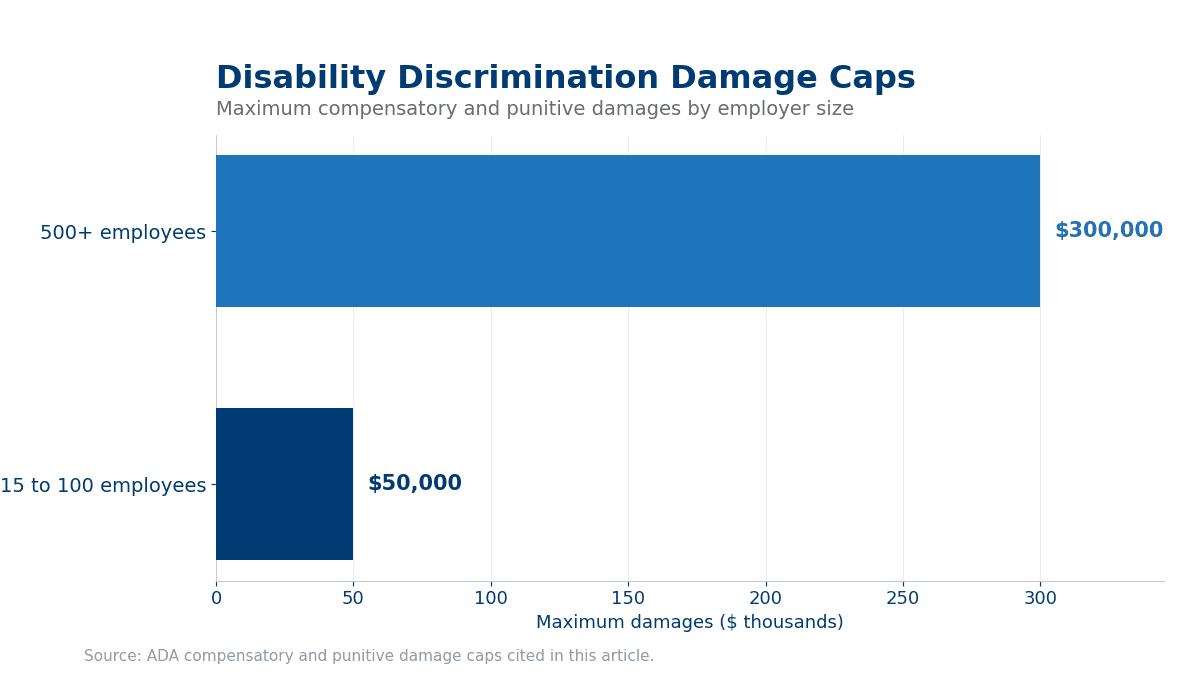
Under the ADA, successful disability discrimination claims can result in back pay, reinstatement or front pay, compensatory damages for emotional distress and loss of enjoyment of life, punitive damages if the employer’s conduct was especially egregious, and attorney’s fees. Compensatory and punitive damages are subject to caps based on the size of the employer, ranging from $50,000 for employers with 15 to 100 employees to $300,000 for employers with more than 500 employees.
Take Action Before Your Rights Expire
If your employer has denied your accommodation request, retaliated against you for disclosing a disability, or terminated you because of your condition, don’t wait to seek legal help. The filing deadlines for disability discrimination claims are among the shortest in employment law, and evidence becomes harder to preserve with each passing day. Contact Harman Law for a confidential consultation to discuss your case.