

When an employer hands you a severance agreement, it can feel like a lifeline after a sudden termination. A few months of continued pay, extended health insurance, maybe a reference letter. But here’s the thing: severance agreements are contracts drafted by your employer’s attorneys to protect the company, not you. Buried inside the seemingly generous terms are clauses that can waive your right to sue for discrimination, keep you from working for a competitor, silence you about workplace misconduct, and even require you to pay back the severance if you violate a single provision. Before you sign anything, a severance agreement lawyer in North Carolina at Harman Law should review every word.
At Harman Law, we review and negotiate severance agreements for employees across the Charlotte and Huntersville area. We’ve seen employers use these agreements to quietly resolve discrimination claims, silence whistleblowers, and lock workers into restrictive non-compete clauses that limit their future careers. We make sure you understand exactly what you’re giving up before you sign.
The General Release: Signing Away Your Right to Sue
Nearly every severance agreement contains a general release of claims. This clause requires you to waive your right to sue the employer for any and all claims arising from your employment, including discrimination, harassment, retaliation, unpaid wages, and wrongful termination. Here’s the catch: once you sign, those claims are gone permanently, no matter how strong they might have been.
If you were terminated under circumstances that suggest age discrimination, gender discrimination, retaliation for reporting safety violations, or any other protected activity, the severance offer may be the company’s way of buying your silence before you realize the full value of your claim. An employment lawyer can evaluate whether the severance amount reflects the true value of what you’re giving up.
Non-Compete and Non-Solicitation Clauses
Many severance agreements include or reinforce non-compete clauses that restrict where you can work after leaving the company. In North Carolina, non-compete agreements are enforceable if they’re reasonable in scope, duration, and geographic area. A severance agreement that extends an existing non-compete or introduces a new one can seriously limit your ability to find comparable work in your field.
Non-solicitation clauses prevent you from contacting the company’s clients, customers, or employees after you leave. These clauses can be especially damaging if your career depends on relationships you built during your employment. Before accepting severance with a non-compete or non-solicitation clause, have an attorney evaluate whether the restrictions are enforceable and whether the severance amount adequately compensates you for the career limitations.
Confidentiality and Non-Disparagement Traps
Confidentiality clauses in severance agreements typically prohibit you from disclosing the terms of the agreement itself, and they may extend to the circumstances of your departure. Non-disparagement clauses prevent you from making negative statements about the company, its management, or its products. These may seem reasonable on the surface, but they can have serious consequences.
If you were fired after reporting harassment or safety violations, a confidentiality clause effectively silences you about the misconduct. And if the non-disparagement clause is one-sided, meaning you can’t criticize the company but the company is free to say whatever it wants about you, you may find yourself unable to explain the circumstances of your termination to future employers. These clauses should always be mutual, and an attorney can negotiate protections that work both ways.
The Older Workers Benefit Protection Act
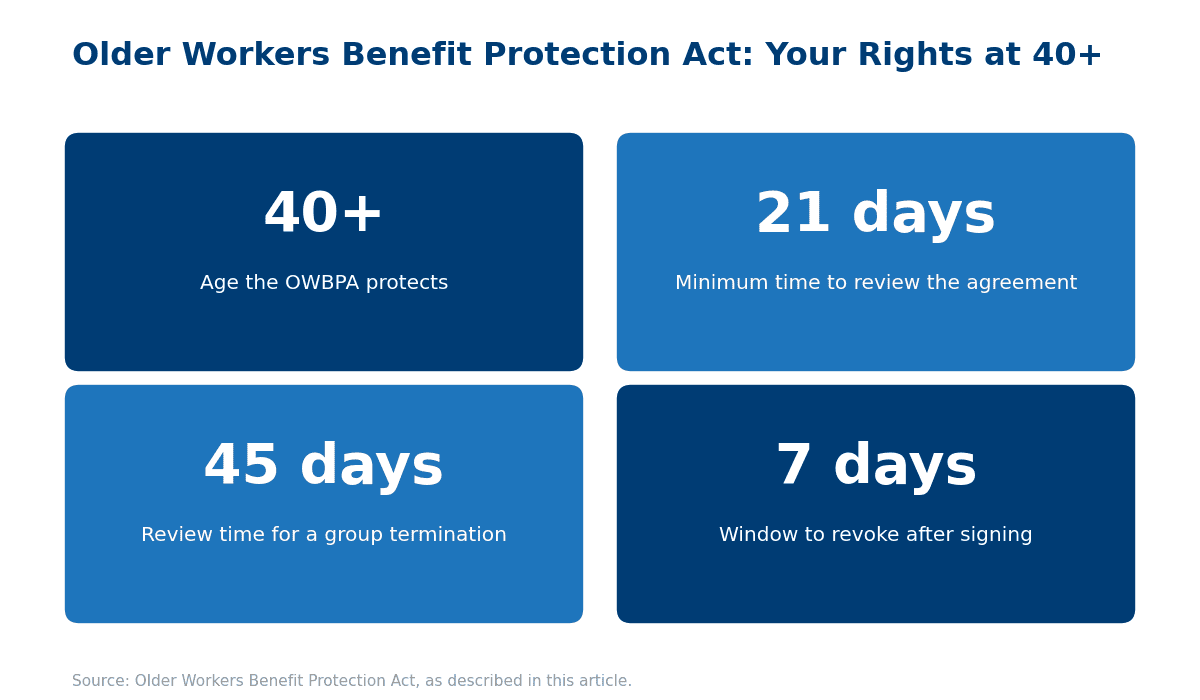
If you’re 40 years of age or older, the Older Workers Benefit Protection Act provides specific protections when you’re asked to sign a severance agreement that includes a waiver of age discrimination claims. Under the OWBPA, the employer must give you at least 21 days to consider the agreement, or 45 days if the severance is part of a group termination. You also have 7 days after signing to revoke the agreement. The agreement must be written in plain language, specifically reference your rights under the Age Discrimination in Employment Act, and advise you to consult with an attorney.
If the employer fails to meet any of these requirements, the waiver of your age discrimination claims may be unenforceable, even if you already signed. This is one of the most commonly overlooked protections for older workers, and it can preserve legal claims the employer assumed you had given up.
Negotiating a Better Severance Package
Most employees don’t realize that severance agreements are negotiable. The initial offer is rarely the employer’s best offer. An experienced severance agreement lawyer can negotiate for increased severance pay, extended health insurance coverage, removal or narrowing of non-compete restrictions, neutral or positive reference language, mutual non-disparagement provisions, and outplacement services.
The leverage in negotiation often comes from the claims you’d be waiving. If you have a strong potential discrimination or retaliation claim, the value of the general release goes up significantly, and the employer knows it. An attorney can assess the strength of your potential claims and use that assessment to negotiate a severance package that reflects their true value.
Do Not Sign Without Legal Review
The pressure to sign quickly is intentional. Employers want you to accept the agreement before you have time to consult with a lawyer or fully understand what you’re giving up. So if you’ve been offered a severance agreement, use the review period you’re entitled to and contact Harman Law for a confidential consultation. We can review the agreement, identify hidden risks, and negotiate terms that protect your interests.